
July 17, 2026
What is Heavy Lift Rigging?
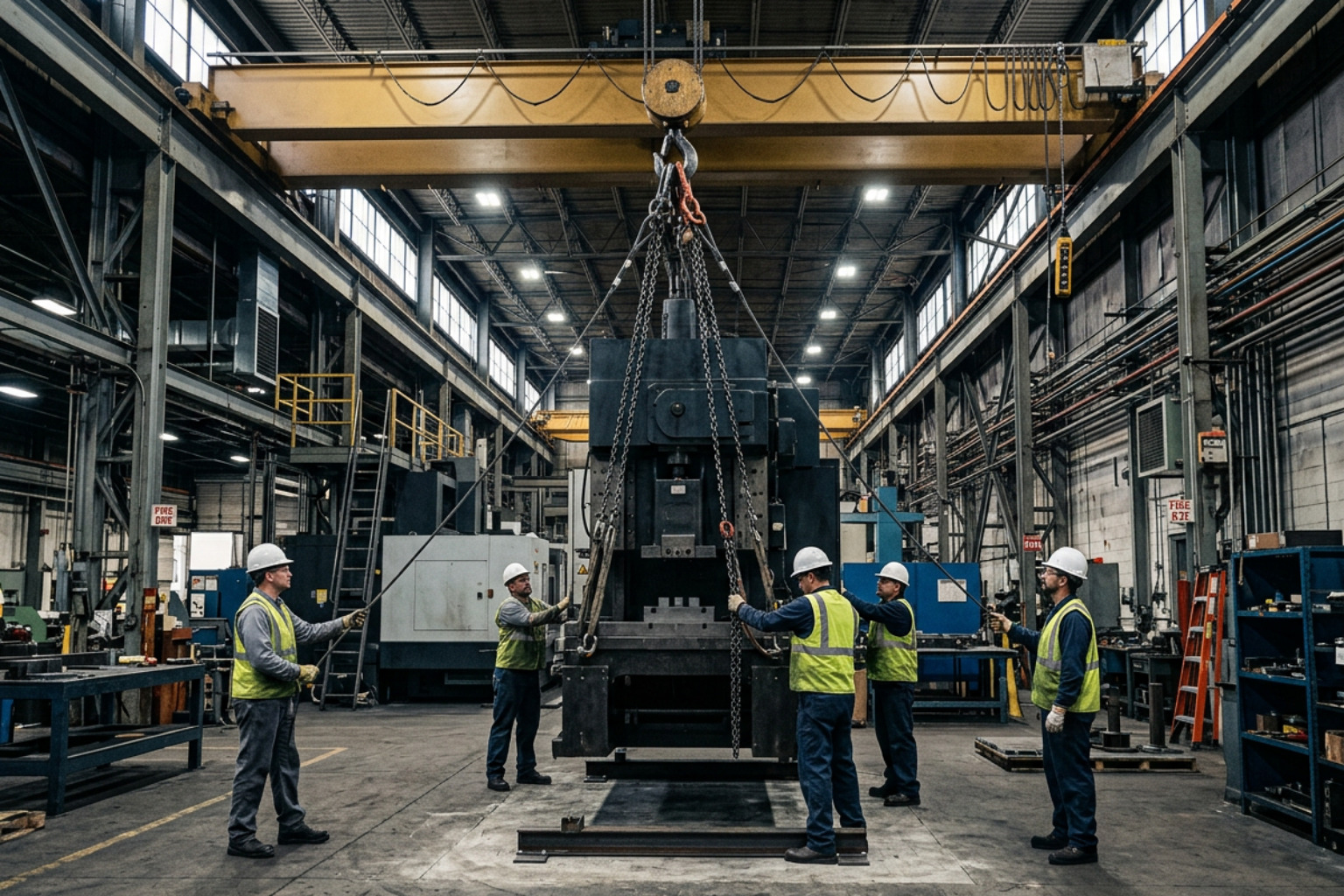
Heavy lift rigging is the specialized process of planning, engineering, and executing lifts that exceed the capacity of standard rigging operations. It typically applies to lifts requiring a formal engineered lift plan because of weight, complexity, or risk.
Quick answer: What is heavy lift rigging?
| Factor | Detail |
|---|---|
| Definition | Lifting and moving loads too large or complex for standard rigging methods |
| Common threshold | Loads exceeding 75% of a crane’s rated capacity, or requiring specialized equipment, are widely treated as critical lifts under industry practice |
| Equipment used | Hydraulic gantries, strand jacks, SPMTs, jack-and-slide systems, multi-crane configurations |
| Engineering required | Qualified-person lift plans (PE review for the largest or most complex lifts), ground bearing studies, load calculations |
| Governing standards | OSHA 29 CFR 1926 Subpart CC (construction lifts); 29 CFR 1910.179, 1910.180, and 1910.184 (general industry/plant work); ASME B30 series |
| Industries | Power generation, petrochemical, food processing, manufacturing, infrastructure |
The stakes are high. Industrial equipment can weigh hundreds of thousands, sometimes millions, of pounds and cost millions of dollars to fabricate. A failure mid-lift doesn’t just damage equipment. It stops the entire project, puts workers at risk, and drives up costs fast.
Poor rigging planning is one of the fastest ways to delay a project and increase on-site risk. For plant and facility managers, that means extended downtime, missed production targets, and potential safety incidents that could have been prevented.
This guide covers everything you need to execute heavy lift rigging safely, from how lifts are classified and engineered to the equipment used, common mistakes, and what to look for in a rigging team.
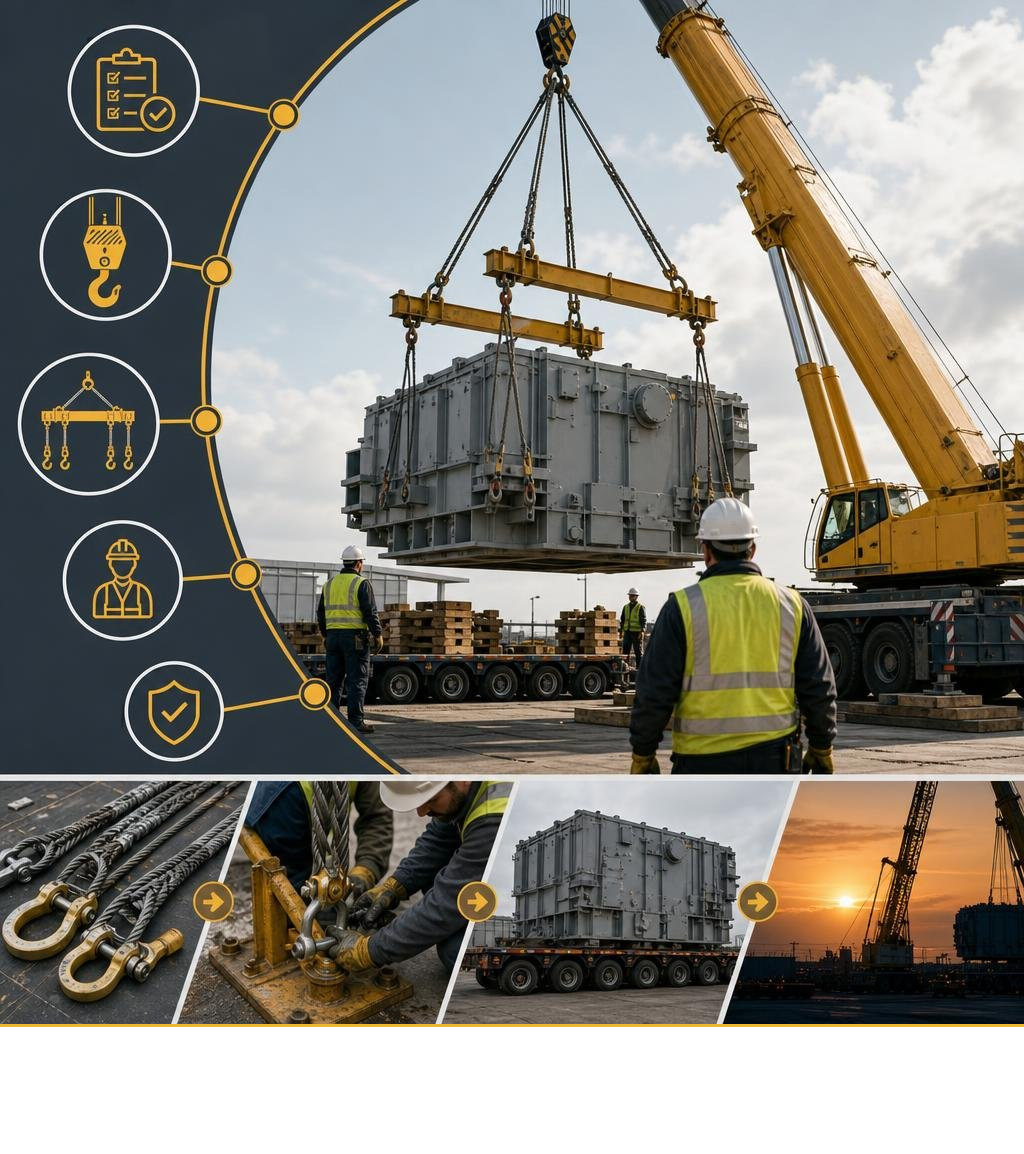
Key Takeaways for Plant and Facility Managers
When managing an industrial facility in New England, heavy lifting projects represent a critical path where there is zero margin for error. Understanding the logistical and safety parameters of these moves is key to protecting your personnel and your bottom line.
- Rigging is on the critical path: Because high-value machinery can take months or years to fabricate, any delay or failure during the lift halts the entire project.
- Safety is an engineering discipline: True heavy lifting relies on precise mathematical calculations, structural analysis, and engineering oversight, not just physical strength.
- Alternative systems save space and money: When overhead space is limited, specialized tools like hydraulic gantries or jack-and-slide systems can bypass the need for massive, expensive cranes.
- Preparation minimizes downtime: Thorough site preparation and clear communication prevent costly scheduling delays and minimize operational disruptions.
For operations leaders across Massachusetts, New Hampshire, Maine, and Rhode Island, coordinating these high-stakes moves requires a deep understanding of local infrastructure and facility constraints.
What Qualifies as Heavy Lift Rigging?
While standard rigging handles day-to-day machinery moves, heavy lift rigging begins when a project surpasses standard lifting boundaries. In the industrial contracting sector, a lift is generally classified as “heavy” or “critical” when the load weight, physical dimensions, or environmental hazards require a custom-engineered lift plan.
From a regulatory standpoint, OSHA standard 29 CFR 1926.1432 requires a qualified person to develop a written lift plan, reviewed with the crew by a qualified/competent lift director, any time more than one crane or derrick will support a single load. Separately, most engineering teams treat a lift approaching 75% of a crane’s rated capacity as a critical lift requiring the same level of formal planning, even on a single-crane job. That 75% figure is a widely used industry convention, not a specific percentage written into OSHA’s regulation. Additionally, standards like ASME B30.1 govern the use of specialized high-capacity jacking systems, industrial rollers, and hydraulic gantries.
It’s also worth noting that Subpart CC specifically governs cranes and derricks on construction sites. For rigging and machinery moves inside an already-operating manufacturing facility, which makes up the bulk of this kind of work, General Industry standards 29 CFR 1910.179 (overhead and gantry cranes), 1910.180 (mobile and crawler cranes), and 1910.184 (slings) are typically the applicable framework instead.
In heavy manufacturing sectors such as food and beverage processing, paper and pulp, and power generation, heavy lifts regularly involve massive components:
- Industrial boilers and steam drums
- Multi-ton stamping and extrusion presses ranging from 600 to 2,000 tons
- Large-scale electrical transformers and switchgear
- Heavy distillation columns and industrial vessels
Executing these lifts safely requires moving away from standard mobile cranes and adopting highly engineered solutions.
Engineering Requirements for Heavy Lift Rigging
Every heavy lift must be treated as a rigorous engineering project. Before any equipment is mobilized to a New England facility, a comprehensive lift plan must be developed and reviewed by a qualified person, with a professional engineer (PE) brought in for the largest or most complex lifts.
Rigging engineering involves several critical calculations:
- Center of Gravity (CG) Determination: Locating the exact 3D center of gravity to prevent the load from shifting or tilting unexpectedly.
- Finite Element Analysis (FEA): Performing structural analysis on non-standard lifting lugs, spreader bars, and temporary support structures to ensure they can withstand the dynamic forces of the lift.
- Ground Bearing Capacity Studies: Evaluating the soil or concrete floor stability. Heavy cranes and gantries exert massive concentrated forces; geotechnical studies confirm if the ground can support these loads or if specialized steel matting is required.
- Rigging Hardware Sizing: Selecting and verifying that all shackles, slings, and spreader beams meet strict safety design factors, typically 5:1 for standard hardware.
Understanding these calculations is fundamental to on-site safety.
Specialized Equipment Used in Heavy Lift Rigging
When standard mobile cranes are physically restricted by tight indoor footprints or overhead power lines, alternative heavy rigging systems provide controlled, compact, and cost-effective solutions.
- Hydraulic Gantry Systems: These systems offer self-contained lifting operations with capacities ranging from 75 to over 900 tons. They are ideal for low-clearance indoor environments where a crane cannot fit.
- Strand Jacks: Operating on a concrete post-tensioning principle, strand jacks act like linear winches. Guided steel cables pass through a hydraulic cylinder, using mechanical wedges to grip and lift loads up to thousands of tons with extreme vertical precision.
- Jack-and-Slide Systems: These systems use high-capacity hydraulic jacks to lift a load vertically, allowing low-profile slide tracks to be inserted underneath. The load is then pushed horizontally along the tracks, making it perfect for placing heavy electrical transformers in tight substations.
- Self-Propelled Modular Transporters (SPMTs): Multi-axle, computer-controlled platform vehicles capable of moving mega-structures weighing thousands of tons across congested job sites.
- Heavy-Duty Forklifts and Booms: A versatile fleet of high-capacity forklifts, ranging from 2-ton to 60-ton capacities, equipped with hydraulic booms provides the flexibility needed to maneuver heavy machinery through tight factory doors.
For projects where traditional crane setups are still the most efficient choice, selecting the right crane configuration is essential.
The Step-by-Step Heavy Lifting Process
A successful heavy lift is never an accident. It is the result of a structured, highly disciplined process that coordinates engineering, specialized equipment, and skilled personnel.
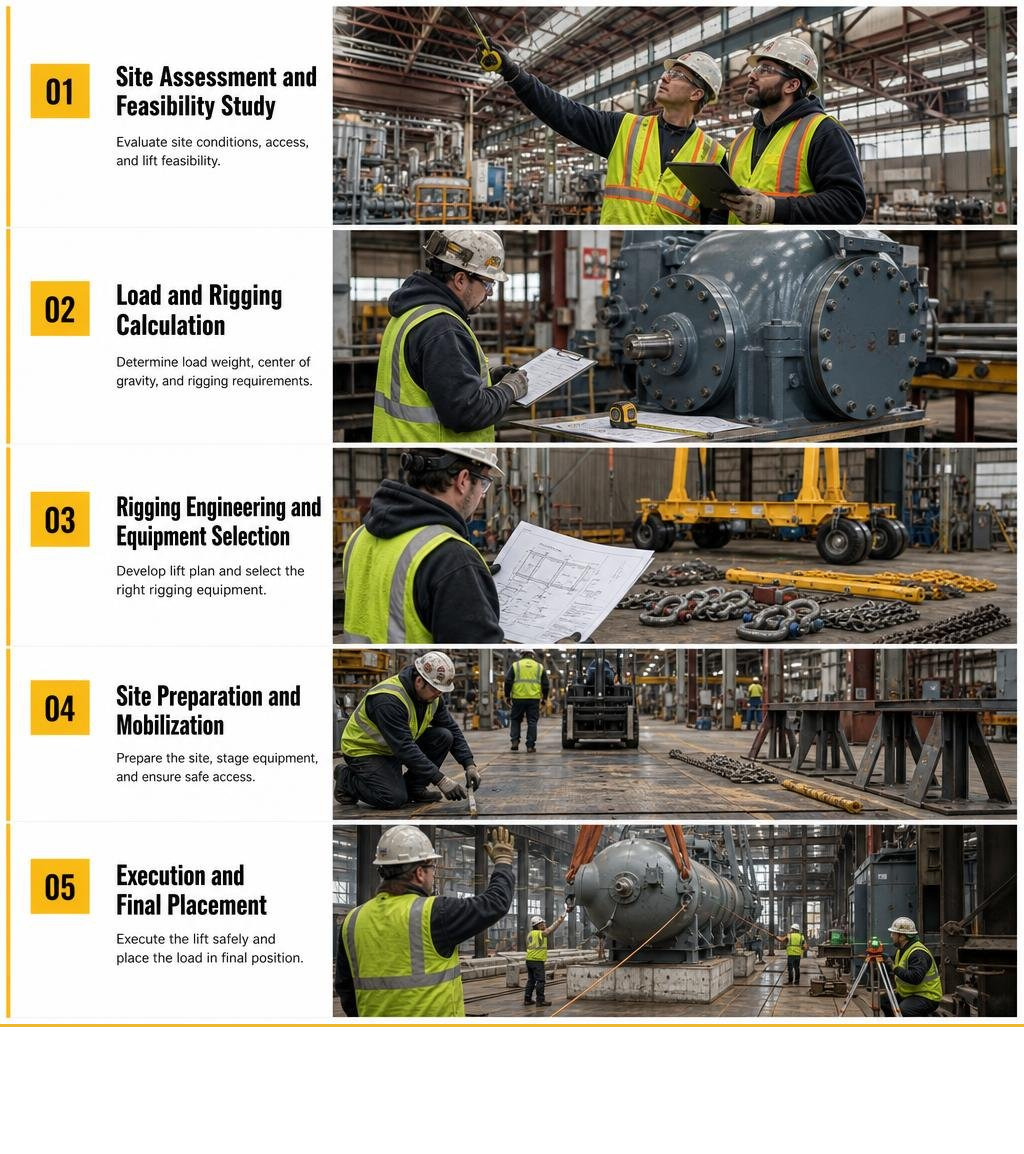
Step 1: Site Assessment and Feasibility Study
The process begins with a thorough walkthrough of the New England facility. Rigging engineers measure overhead clearances, door widths, floor load limits, and identify potential underground hazards like utility lines or basement voids.
Step 2: Load and Rigging Calculation
Engineers determine the exact weight and dimensions of the machinery. If manufacturer documentation is unavailable, the weight is calculated manually by multiplying the material’s volume by its density, adding a safety margin to account for internal components or accumulated fluid.
Step 3: Rigging Engineering and Equipment Selection
A detailed lift plan is drawn up using CAD-based simulations. Engineers select the optimal equipment, whether a tandem crane lift, a hydraulic gantry, or a jack-and-slide system, and design custom lifting attachments if standard rigging points are insufficient.
Step 4: Site Preparation and Mobilization
The facility is prepared by clearing paths, staging equipment, and verifying ground stability. Structural modifications, such as fabricating temporary mezzanine supports or removing non-load-bearing walls, are completed during this phase.
Step 5: Execution and Final Placement
With all safety protocols verified and a pre-lift briefing completed, the rigging crew executes the move. Using real-time load monitoring and synchronized controls, the load is lifted, positioned, and leveled to within fractions of an inch.
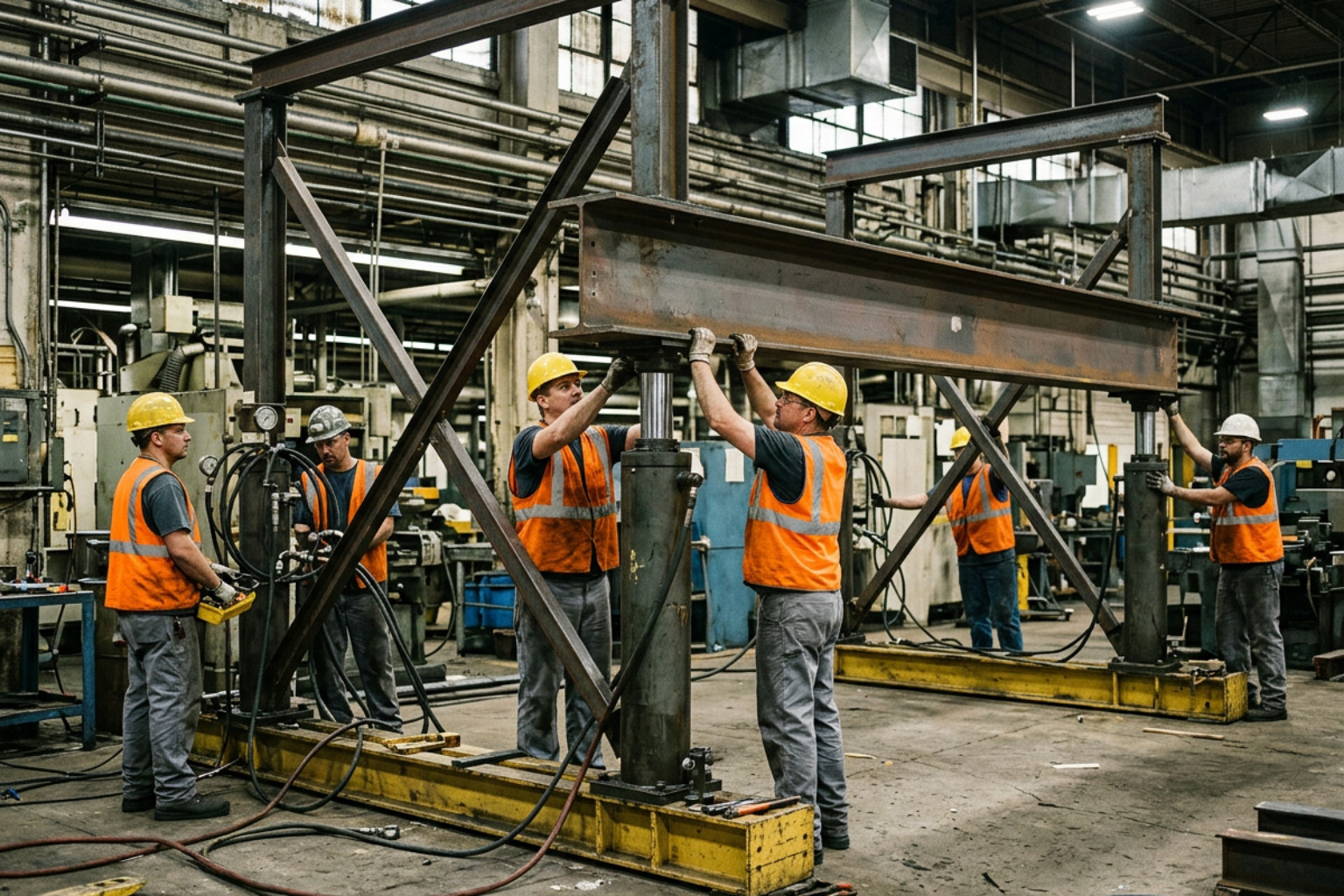
Executing this sequence correctly protects both your employees and your equipment.
Common Mistakes and Risks in Heavy Rigging Operations
Even minor oversights in heavy lifting can lead to catastrophic failures, structural damage, or severe project delays. Understanding where projects typically fail allows facility managers to proactively mitigate risks.
- Failing to Account for Internal Weight: During maintenance or decommissioning, industrial vessels can accumulate internal fouling, heavy residues, or trapped liquids. Lifting a piece of equipment based solely on its “dry” manufacturer weight can easily overload the rigging system.
- Ignoring Wind and Weather Variables: High winds act as a sail on large, suspended loads. Heavy lifts should have strict stop-work criteria based on the crane and rigging manufacturer’s specified wind limits, commonly in the 20 to 25 mph range for larger booms and loads with significant surface area.
- Neglecting Ground Stability: Unstable, saturated soil or unverified concrete floor capacities can cause crane outriggers or gantry legs to sink, leading to tipping hazards.
- Using Worn or Improper Rigging Gear: Abrasive concrete surfaces, sharp metal edges, and exposed rebar can easily damage standard rigging slings. Using high-performance fiber slings, which weigh roughly one-tenth as much as traditional steel wire rope of comparable capacity, combined with protective edge guards drastically reduces wear and tear.
Selecting an experienced partner is also crucial.
Frequently Asked Questions About Heavy Rigging
What is the difference between standard rigging and heavy lifting?
The primary difference lies in the engineering complexity and risk profile rather than an arbitrary weight limit. Standard rigging generally uses mobile cranes, forklifts, or basic chain hoists to move loads under standard safety parameters.
Heavy lifting involves “critical lifts” that require custom-engineered lift plans, specialized high-capacity equipment like strand jacks or hydraulic gantries, and extensive structural calculations to ensure the facility floor and the rigging points can handle the concentrated loads safely.
How do you calculate the weight of an unknown load during demolition?
When manufacturer blueprints are missing, engineers calculate the weight of a load using the formula:
Load Weight = Volume of Material × Material Density
For demolition projects where internal structural modifications or hidden debris add uncertainty, rigging teams utilize substantial safety capacity margins, often doubling the initial weight estimates. They also employ real-time load cells to verify the weight of the load as tension is slowly applied, before the structure is fully detached.
When should you use a jack-and-slide system instead of a crane?
A jack-and-slide system should be used when:
- Overhead clearance is extremely limited: Indoor spaces, low ceilings, or nearby overhead power lines make crane booms impossible to deploy.
- Access is restricted: Tight spaces, such as electrical substations or congested factory floors, prevent a large crane from positioning close enough to the pad.
- Cost efficiency is a priority: Mobilizing a massive crane can be cost-prohibitive. A jack-and-slide system provides a compact, highly controlled alternative that minimizes site disruption.
Properly preparing your site for this equipment is key to a smooth transition.
Conclusion
Heavy lift rigging is a highly technical discipline where safety, engineering precision, and specialized equipment must come together seamlessly. For plant and project managers across Massachusetts, New Hampshire, Maine, and Rhode Island, selecting a rigging partner with a proven record of safety and execution is the single most important decision of the project.
At Atlantic Millwrights, we provide comprehensive industrial contracting, custom fabrication, and heavy rigging services designed to keep your facility running smoothly. Serving heavy manufacturing industries like food and beverage, paper and pulp, and power generation, our highly trained crews operate with a strict focus on safety and efficiency.
Whether you need to install a heavy press, relocate a production line, or coordinate a complex plant shutdown, our team is equipped to deliver on-time, under-budget, and accident-free results.
If you are planning an upcoming machinery move or structural installation in New England, Atlantic Millwrights can help you plan and execute the work safely.