
July 17, 2026
When One Wrong Move Costs You Days of Production
Industrial warehouse equipment movers are specialized contractors who handle the safe disassembly, transport, and reinstallation of heavy machinery, production lines, and warehouse systems, the kind of work a standard moving company simply cannot do.
If you need to relocate industrial equipment, here is what to know upfront:
- Who to hire: A licensed industrial mover or millwright contractor with proven rigging, transport, and reassembly experience
- What they handle: CNC machines, conveyor systems, robotic arms, presses, racking systems, and full production lines
- Why it matters: One misstep during a heavy equipment move can result in days of unplanned downtime, damaged assets, or serious safety incidents
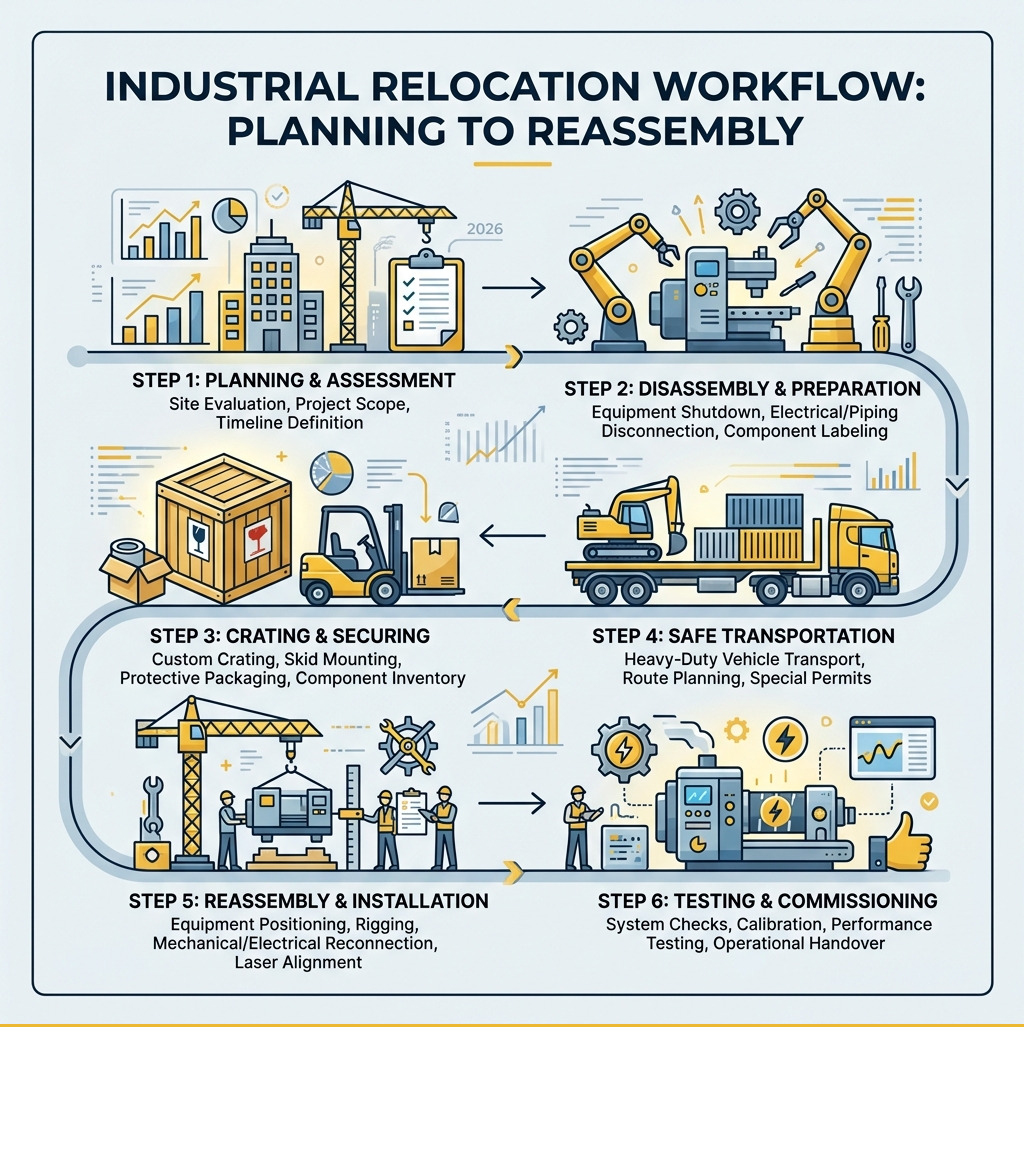
- What the process looks like: Assessment, disassembly, crating/securing, transport, reinstallation, testing
- Key differentiator: Look for teams that use phased relocation planning, laser-tracking for precision alignment, and documented risk assessments
Most plant managers underestimate the complexity until something goes wrong. Maintaining inventory access and keeping production running during a move are consistently the hardest parts of any industrial relocation.
The stakes are real. A machine that is improperly rigged, poorly packed, or misaligned during reinstallation does not just cause damage. It causes delays, cost overruns, and safety exposure that can take weeks to recover from.
This guide covers everything you need to know about planning, executing, and managing an industrial warehouse relocation, from choosing the right contractor to preparing your facility and avoiding the most common mistakes.
Key Takeaways
- Professional planning is the only way to prevent extended manufacturing downtime.
- Specialized rigging and laser-tracking technology ensure precision reassembly.
- Phased relocation strategies allow for continued production during facility moves.
- Safety compliance and risk assessments are non-negotiable for heavy equipment transport.
- Choosing movers with industry-specific expertise (e.g., food processing or data centers) reduces asset damage.
Why Professional Industrial Warehouse Equipment Movers are Essential for Your Facility
Relocating a manufacturing plant or a high-volume warehouse is not a logistical task; it is an engineering challenge. Standard commercial movers lack the specialized tools and technical knowledge required to handle odd-shaped, fragile, or oversized equipment. Hiring professional industrial warehouse equipment movers is essential because they provide a holistic approach that goes beyond “lift and shift.”
Professional movers specialize in heavy equipment moving for warehouse and manufacturing setups, ensuring that every piece of machinery maintains its structural integrity. This includes the precise documentation of production line connections, orientations, and calibrations. When a machine is moved, it isn’t just about getting it to point B; it’s about ensuring it functions at 100% efficiency the moment it is powered on at the new site.
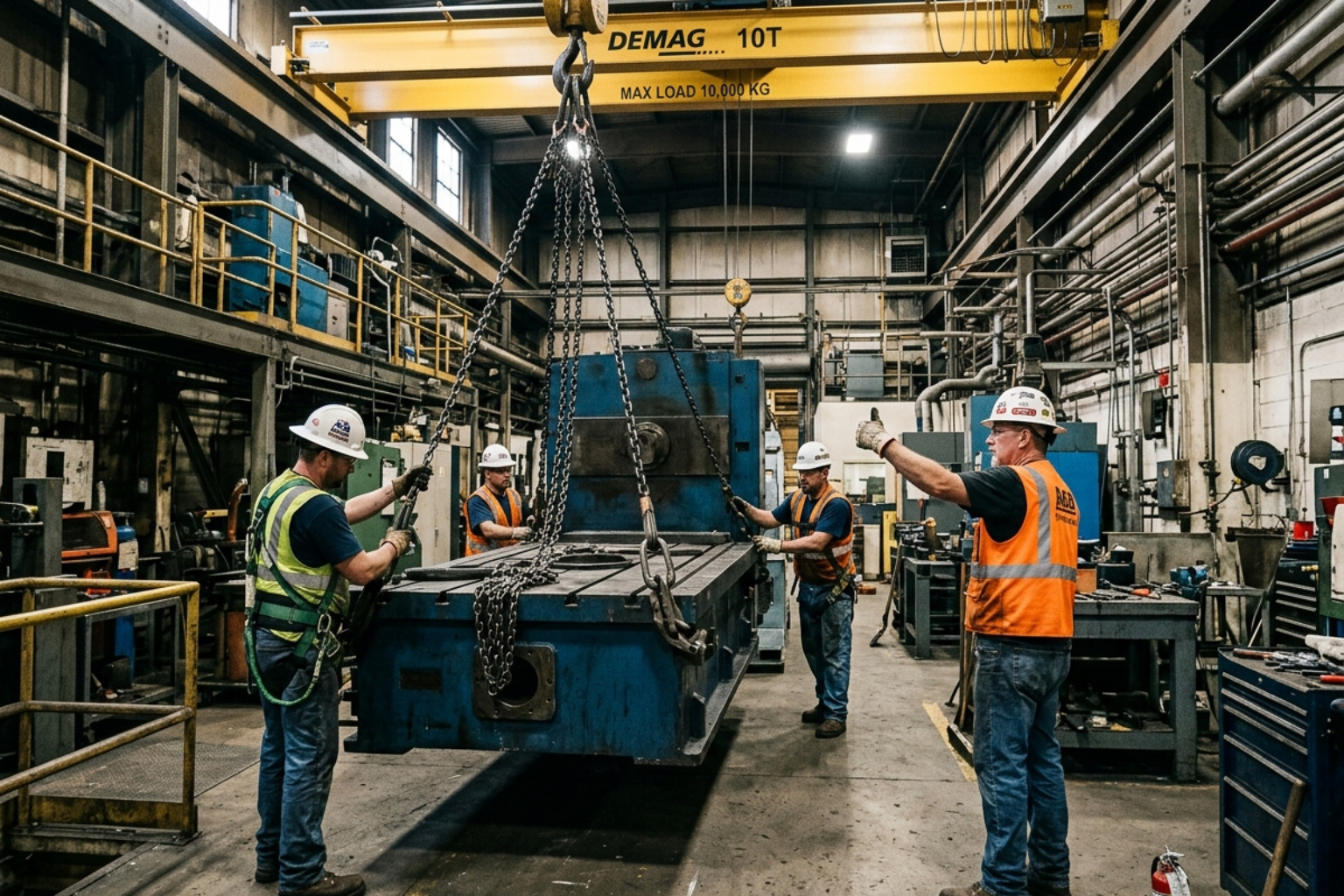
Furthermore, comprehensive warehouse services include specialized rigging and precision leveling. In industries like food processing or paper and pulp, even a fraction of an inch of misalignment can lead to mechanical failure or premature wear. Experts use advanced lifting equipment to navigate tight spaces and complex facility layouts, protecting both the assets and the facility’s floors and walls.
Specialized Services and Technology Used by Industrial Movers
The modern industrial move relies on a combination of brute strength and high-tech precision. Professional movers utilize custom crating and professional pack/prep teams to secure high-value industrial items. For sensitive electronics or small, high-precision fasteners, movers use anti-static materials and vacuum sealers to prevent loss or damage.
Advanced technology has revolutionized the field. Tools like laser-tracking metrology allow for pinpoint precision in machinery alignment. Instead of relying on manual levels, technicians use lasers to ensure that production lines are perfectly straight across hundreds of feet.
Specialized equipment often includes:
- Hydraulic Gantries: Used for lifting and loading heavy machinery where overhead cranes are unavailable.
- CartMover XR: A battery-powered tool with a 10-ton capacity, allowing operators to move heavy wheeled loads safely within a work cell.
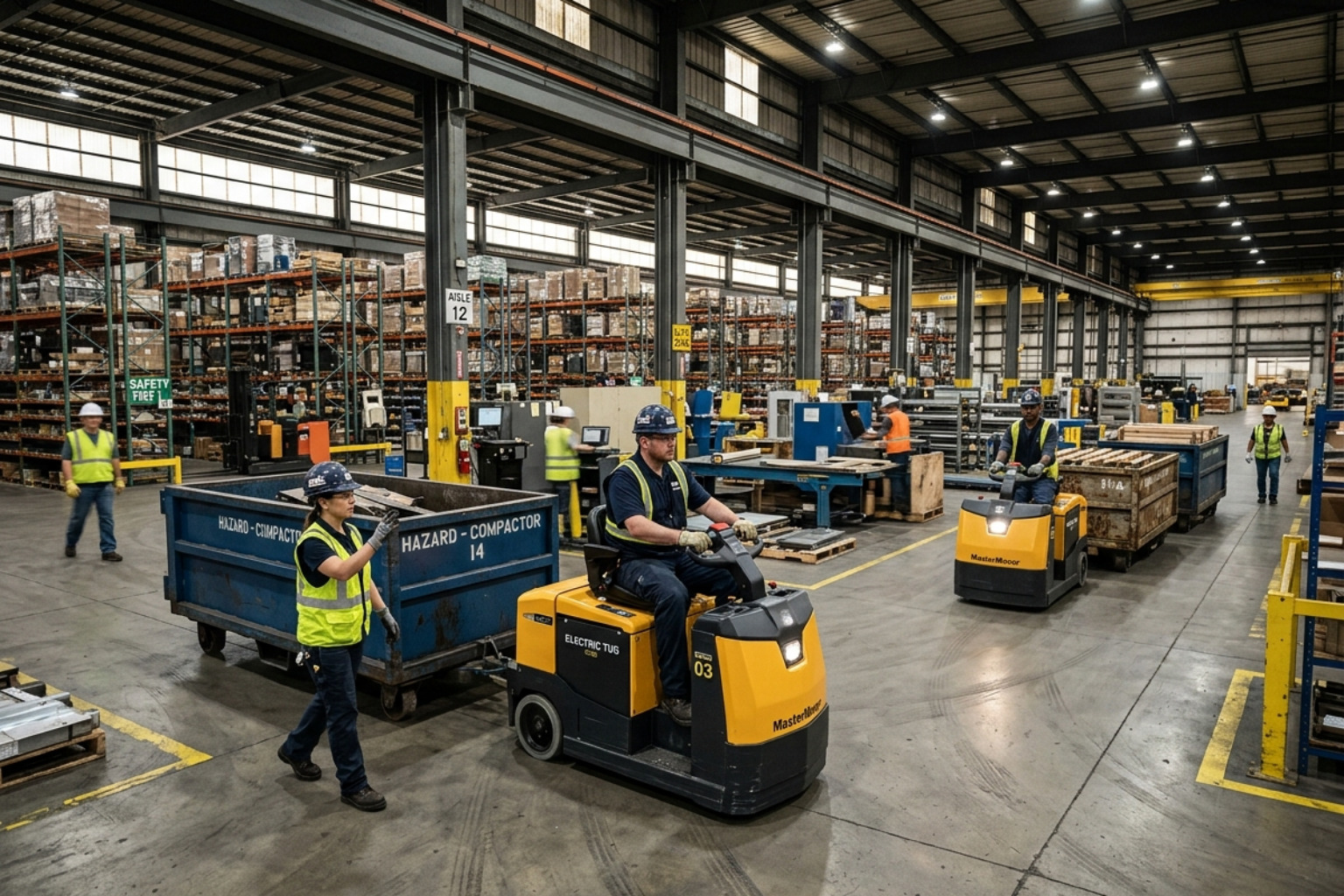
- V-Move 4XL: A powerful walk-along electric tug capable of moving up to 88,185 lbs, often used for pushing or pulling heavy carts and waste compactors.
Advanced Material Handling with Industrial Warehouse Equipment Movers
Efficiency in the new warehouse layout often depends on high-density storage and advanced material handling equipment. Professional movers often coordinate the installation of systems like the Transtacker, a heavy-duty turret truck that allows for storage in aisles as narrow as 54 inches and heights up to 59 feet.
Modern equipment like the 8630 Tow Tractor features PowerSteer technology, which reduces steering effort by up to 90%. These machines utilize AC/DC motors and lithium-ion batteries to provide longer runtimes and lower ownership costs. Integrating these technologies during a relocation ensures that the new facility is more productive than the one left behind.
The Industrial Relocation Process: From Planning to Reassembly
A successful move is built on a foundation of warehouse services: a combination of strategy, skill, and teamwork. Most large-scale moves utilize a phased relocation plan. This involves dividing the move into strategic stages, allowing partial operations to continue in one area while another is being dismantled.
A centralized command center typically oversees the project, managing everything from warehouse racking systems and inventory to the heavy machinery itself. To maintain real-time visibility, movers often use barcode scanning or RFID tagging during the packing process. This ensures that every component is accounted for and can be quickly located for reassembly.
Preparing Your Facility for Industrial Warehouse Equipment Movers
Preparation is the responsibility of the facility manager, but a professional moving team will provide a pre-move checklist to guide the way. Key steps include:
- Documentation: Record current equipment configurations and calibrations.
- Data Backup: Ensure all operational data and PLC programs are backed up.
- Clear Access Paths: Remove obstructions to ensure a clear path for gantries and forklifts.
- Maintenance Identification: Identify any needed repairs that should be performed while the machine is offline.
- Safety Assessments: Review heavy equipment moving safety tips with all on-site personnel.
Managing Risks and Avoiding Costly Mistakes in Heavy Moves
One of the most dangerous decisions a plant manager can make is attempting “in-house” rigging. While it may seem cost-effective, the hidden costs, such as equipment damage, worker injury, or extended downtime, often far outweigh the price of a professional. Finding the best heavy equipment movers for you means finding a partner who understands risk mitigation.
| Feature | Professional Rigging | In-House Moving |
|---|---|---|
| Experience | Decades of specialized skill | Limited to daily operations |
| Equipment | Specialized equipment such as gantries and air skates | Standard forklifts that are often overloaded |
| Insurance | Comprehensive liability and cargo coverage | Standard business insurance that often excludes rigging |
| Safety | Certified riggers and OSHA-compliant processes | Higher risk of accidents and OSHA fines |
| Downtime | Minimized through phased planning | Extended due to trial and error |
Common risks include shock damage to sensitive electronics during transport and unauthorized access to equipment during transit. Professional industrial warehouse equipment movers use vibration-minimizing transport and secure, climate-controlled storage to protect your assets.
Frequently Asked Questions about Industrial Equipment Moving
How do movers handle SCIF or sensitive data center relocations?
Relocating sensitive infrastructure, such as SCIF-adjacent equipment or data centers, requires strict access control. Movers must maintain the accreditation baseline of the equipment. This involves secure transport protocols that prevent unauthorized access and ensure that even unclassified items are handled with a high level of security to mitigate risks to the broader network.
What is the typical timeline for a full factory move in 2026?
The timeline varies significantly based on the project’s scale. A single machine move might take only a few days, whereas a full factory relocation in the New England area (including MA, NH, and ME) can take several weeks. Detailed schedules are developed during the consultation phase, often involving hundreds of project hours to ensure every milestone is met without interrupting the client’s business operations.
How are international machinery moves managed?
International moves require extensive logistics coordination. This includes acquiring necessary permits for oversized loads, custom crating for sea or air freight, and detailed dismantling documentation. Once the machinery reaches its destination, the moving team—or a local partner—performs reinstallation and rigorous testing to ensure the equipment meets its original performance specifications.
Conclusion
Relocating an industrial facility is a high-stakes endeavor where precision and safety are paramount. Atlantic Millwrights provides expert industrial contracting and custom fabrication throughout Massachusetts, New Hampshire, Maine, Rhode Island, and Vermont. Specializing in rigging, installation, and retrofitting, they serve heavy manufacturing industries such as food/beverage and power with a commitment to 24/7 service that minimizes downtime.
By focusing on accident-free execution and staying on budget, they ensure that your transition to a new facility is seamless. If you are planning a complex relocation and require a partner that prioritizes safety and minimal downtime, professional rigging services are the foundation of a successful move.