
June 25, 2026
When Push-Back Rack Installation Goes Wrong, It’s a Big Problem
A warehouse push back rack is one of the most efficient high-density storage systems available — but installing one in a high-bay facility is where things get complicated fast.
What is a warehouse push back rack? Here’s the short version:
| Feature | Detail |
|---|---|
| Storage Method | Pallets stored 2–6 deep per lane on nested carts |
| Rail Type | Inclined rails, gravity-assisted |
| Inventory Rotation | LIFO (Last In, First Out) |
| Max Height | 7.5 m (approx. 25 ft) |
| Typical Depth | 3–4 pallets (up to 6 with rollers) |
| Aisle Access | Single aisle face — no forklift entry into lanes |
| Best For | Medium-turnover goods, 5+ pallets per SKU |
The system works by placing pallets on wheeled carts that ride on angled rails. Each new pallet pushes the previous ones back. When you pull the front pallet, gravity slides the rest forward automatically.
It’s a smart design — when it’s installed correctly.
The rigging and installation phase is where risk is highest. Misaligned rails, improper anchor points, incorrect rail pitch, and inadequate structural anchoring can turn a high-density storage upgrade into a costly safety hazard. In high-bay environments, those risks scale with every foot of height.
This guide covers the full installation process — from layout design to anchoring — and the mistakes that cause delays, damage, and downtime.
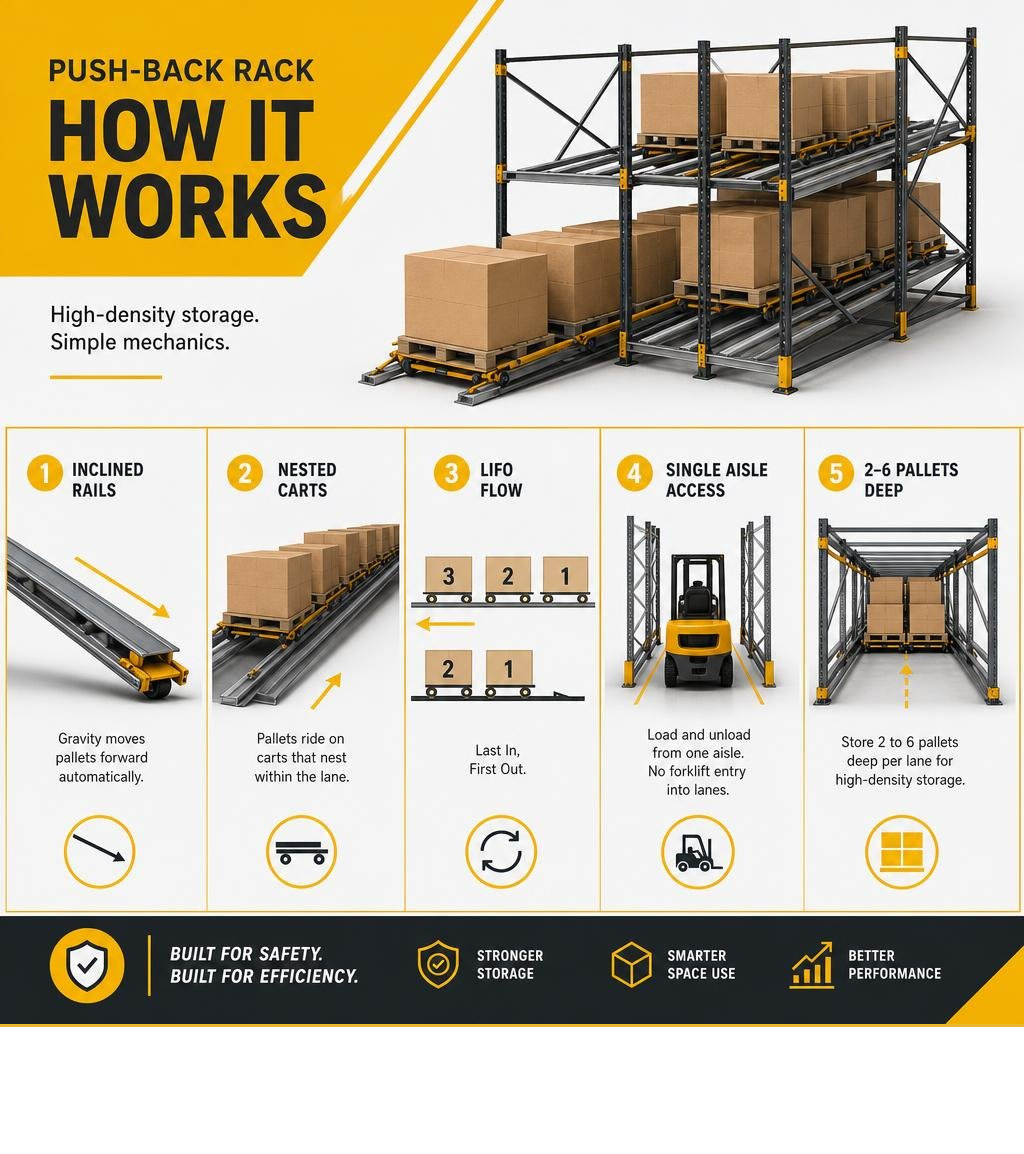
Warehouse push back rack word guide:
What is a Warehouse Push Back Rack and How Does It Work?
A warehouse push back rack utilizes a dynamic cart-on-rail design that offers a practical middle ground between high-density storage and selectivity. Unlike static systems, this setup nests wheeled carts on inclined steel rails pitched at a gradual slope (typically 1/4 to 5/16 of an inch per foot, or about 3 degrees).
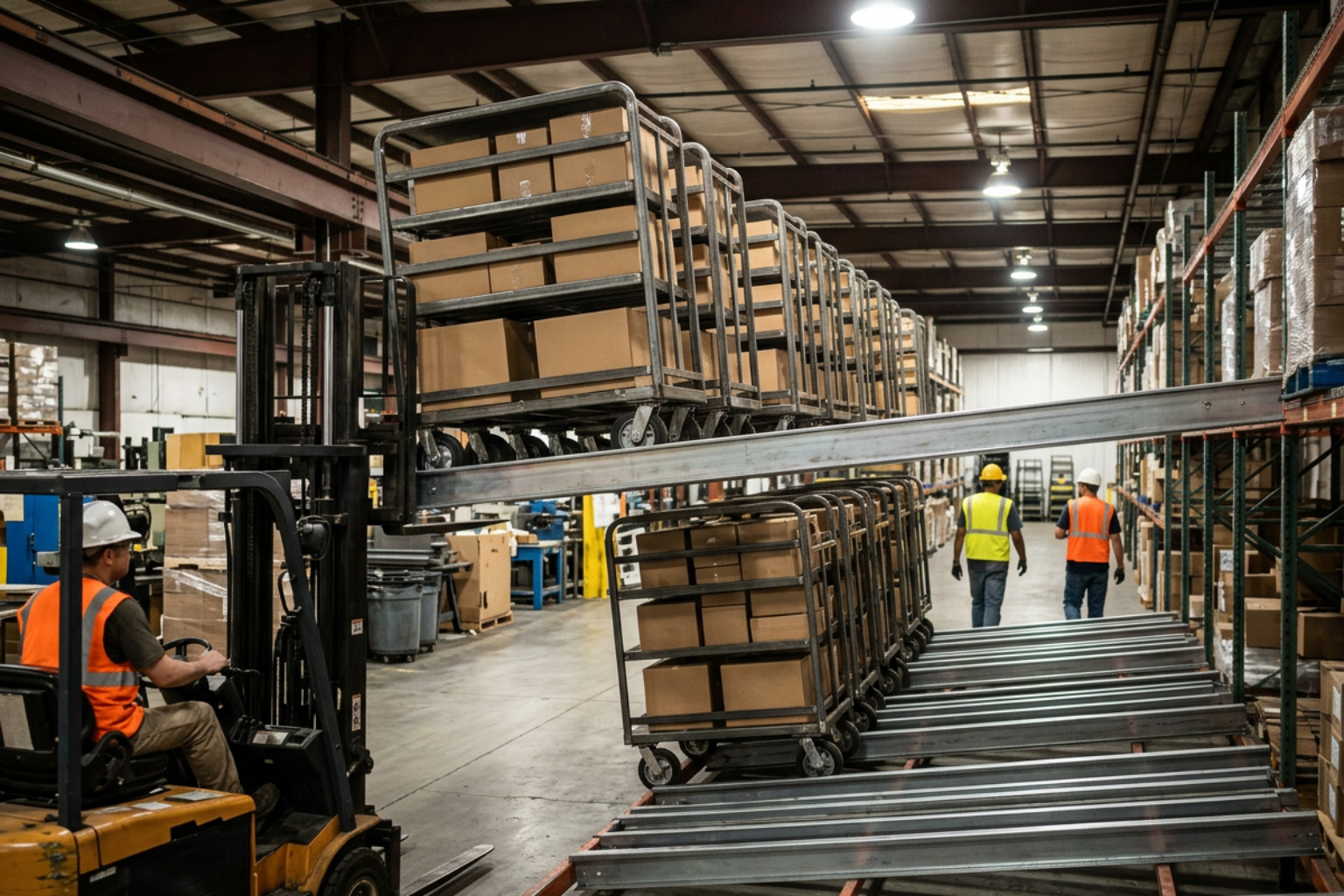
When a forklift operator deposits the first pallet, it sits on the top cart. To load the second pallet, the operator pushes the first pallet back, exposing the nested cart beneath it. This process continues up to six pallets deep. When unloading, the reverse happens: as the front pallet is lifted and removed, gravity gently coaxes the remaining pallets forward to the aisle face.
For facilities evaluating high-density storage options, understanding what a warehouse includes and how different systems perform is critical. Below is a comparison of how a warehouse push back rack stacks up against other standard options:
| Racking Type | Storage Density | SKU Selectivity | Inventory Rotation | Forklift Entry Required? |
|---|---|---|---|---|
| Selective Racking | Low | 100% (Every pallet) | FIFO or LIFO | Yes (Aisle access only) |
| Drive-In Racking | High | Low (Bay-level only) | LIFO | Yes (Must enter rack structure) |
| Pallet Flow Racking | High | Low (Lane-level only) | FIFO | No (Load rear, pick front) |
| Push-Back Racking | High (Up to 90% more) | Moderate (Lane face only) | LIFO | No (Aisle face only) |
Push-back designs allow operations to store multiple SKUs across different levels of the same bay. This provides far better selectivity than drive-in systems, which require the exact same SKU throughout the entire bay.
To determine how to best integrate these components into your facility, it helps to understand What Does a Warehouse Include? and how dynamic systems impact overall floor layout and traffic flow.
Rigging and Installing High-Density Systems: The Step-by-Step Process
Installing a high-density warehouse push back rack is a complex engineering and rigging task. Because the system relies on gravity and physical force to move heavy pallets, there is zero margin for error during assembly.
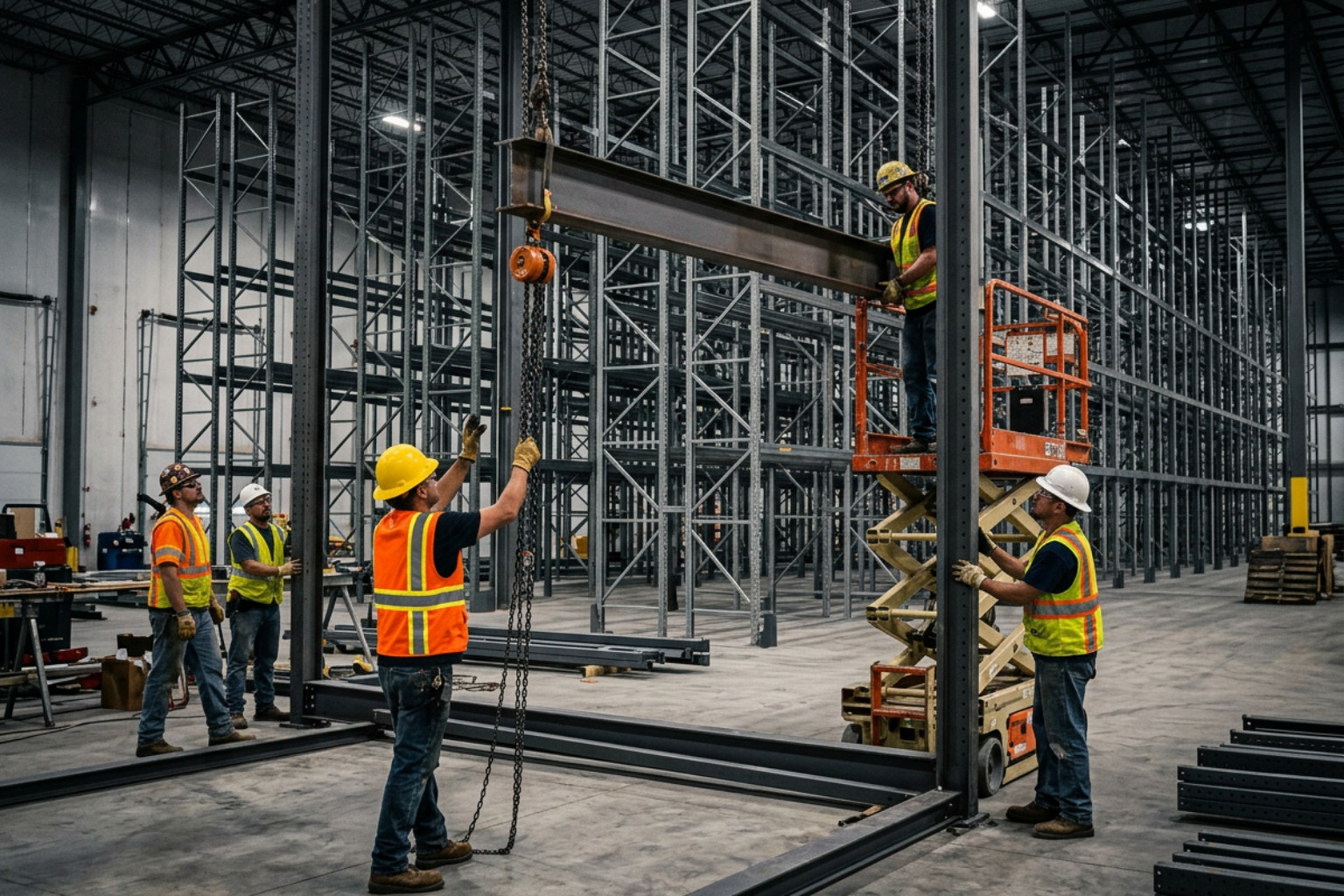
At Atlantic Millwrights, our specialized Warehouse Services teams handle these installations with millimetric precision. The process requires heavy-duty structural steel, robust bolted connections, and exact alignment of the mechanical tracks.
Designing the Warehouse Push Back Rack Layout
Before a single bolt is tightened, the entire system must be custom-engineered for your specific inventory profile. Layout design factors include:
- Lane Depth: Standard systems range from 2-deep to 6-deep configurations.
- Cart Capacity: Typically engineered to support 2,500 to 3,000 lbs per cart level.
- Forklift Clearance: Ensuring the aisle width accommodates the forklift’s turning radius.
- Bay Width: Calculated by taking the pallet’s front dimension (including any load overhang) and adding a safety clearance of 150 mm (75 mm on each side).
For high-volume operations, technical layouts often combine different storage styles. Experienced teams often use push-back configurations in hybrid warehouse layouts, placing push-back bays next to selective racks to balance bulk storage with active order-picking zones.
Securing and Anchoring the Warehouse Push Back Rack Structure
Once the upright frames and beams are erected, securing the structure to the concrete slab is the most critical safety step.
Because forklifts must push against the weight of multiple nested pallets, the rack frames experience constant lateral forces. Installers use heavy-duty floor anchors and seismic bracing to prevent structural shifting over time.
Every upright frame must be plumbed, leveled, and secured with structural bolts. This step ensures that the engineered rail pitch remains perfectly consistent across every single lane, maintaining safe load capacities and smooth cart operation.
Critical Risks and Mistakes in High Bay Rack Rigging
In high-bay warehousing, small installation errors translate directly into major operational failures. When rigging a warehouse push back rack, three mistakes stand out as the most common and costly:
- Improper Rail Pitch: If the slope is too steep, pallets will slide forward with dangerous velocity, risking run-offs or impact damage. If the slope is too shallow, the carts will hang up, requiring operators to manually pull heavy loads forward—a major safety hazard.
- Misalignment of Nested Carts: If the upright frames are out of plumb by even a fraction of an inch, the nested carts will bind or jam. This leads to stuck inventory, damaged wheels, and increased wear on the rack structure.
- Inadequate Floor Anchoring: Failing to account for the pushing force of the forklift can cause the front columns to shift. Over time, this compromises the load capacity of the system and risks a catastrophic rack collapse.
If your facility is undergoing a layout change or relocation, managing these risks is paramount. Working with professionals who understand how to make Heavy Equipment Warehouse Moving Made Easy ensures that your high-density racking is dismantled, transported, and reinstalled without compromising its structural integrity.
Frequently Asked Questions About Push-Back Racking
High-density dynamic storage systems often prompt technical questions from operations managers looking to optimize their space.
How does cold storage affect cart-and-rail systems?
Push-back systems perform exceptionally well in cold storage and freezer environments (operating reliably from -30 °C to 40 °C). Because they consolidate storage, they reduce the total volume of air that needs to be refrigerated, saving significant energy costs.
To prevent freezing or binding, cart wheels must be equipped with stainless steel bearings and treated with specialized, low-temperature lubricants that resist condensation.
What are the maintenance requirements for gravity-fed racks?
Because push-back systems are mechanically simple and do not use motors, they require minimal maintenance. However, facilities should conduct quarterly visual inspections to check for:
- Debris or dust accumulation along the sloped rails.
- Flat spots or wear on the cart wheels.
- Damaged safety stops or misaligned pallet guides.
- Loose floor anchors or damaged column guards.
What is the maximum depth and height for these systems?
The standard maximum depth is 6 pallets per lane (typically using a roller-based system for 5 to 6 deep, and nested carts for 2 to 4 deep). The typical maximum height is 7.5 meters (approximately 25 feet).
This height limit is dictated by forklift mast rigidity; operators need sufficient visibility and pushing force to safely manage nested pallets at higher elevations.
Conclusion
A warehouse push back rack is an outstanding investment for New England businesses looking to maximize storage density without losing SKU selectivity. However, because these systems rely on precise physical angles and constant mechanical force, their safety and longevity depend entirely on the quality of their installation.
Atlantic Millwrights provides expert industrial contracting and custom fabrication throughout Massachusetts, New Hampshire, Maine, Rhode Island, and Vermont. Our rigging crews bring decades of experience to complex high-bay racking projects, ensuring absolute safety compliance, precise alignment, and minimal operational downtime.
If you are planning a racking upgrade or facility relocation and want to ensure your high-density systems are installed safely and efficiently, Atlantic Millwrights Rigging Services can help you execute the project on time and within budget.